Inter-Government Affairs
Fish & Wildlife
Seabird Island's leadership works tirelessly to protect Indigenous access to fisheries and natural habitats in our territory. Learn about our advocacy efforts and stewardship initiatives.
At a glance
Team Lead
Jillian Stewart-Szpak, RPBio
Phone
(604) 796-6885
Join Field Work
Share Your Interests
Updated
Thank you to everyone that attended Fish & Wildlife’s third annual Ripple Report event! Our team was appreciative of the thoughtful comments and feedback received at this year’s event. We have summarized the most frequent feedback received during the event. Stay tuned for the recording of the 2026 presentation!
In 2026, we’re looking forward to bringing Community Members out into the field with us!
- Fish & Wildlife Team
Are you interested in joining our work?
If you’re a Seabird Island member and interested in joining our team out in the field, please fill out this form to be added to our email list. When you sign up for our email list, you will receive an email when there is an opportunity to join our team in the field. These emails will describe the type of survey, the necessary level of physical ability, what you can expect, and how to express your interest for that day of field work.
At this time we are reviewing our options for inviting volunteers in the field, please stay tuned for updates.
Protecting Indigenous Fishing Rights and Habitat at Seabird Island
sAt Seabird Island, fisheries and environmental stewardship is a top priority. Our elected Chief and Council members actively advocate for Indigenous fishing rights and habitat protection through:
- Participating in high-level provincial and federal negotiations
- Staying informed on fish populations and habitat status
- Providing input on proposed development projects
- Advocating for the rights of Indigenous people
- Taking political action to defend lands and resources
Seabird’s Fisheries & Wildlife team collaborate with local experts, consultants, and Indigenous knowledge holders to study and conserve critical habitat in our territory. Examples include conducting salmon spawner surveys and restoring sections of Maria Slough to improve flow and access for fish.
The Fisheries & Wildlife team conducts technical reviews of proposed land and waterway developments to assess environmental impacts and propose appropriate offsetting measures. While liaising with government agencies and industry stakeholders, our Fisheries & Wildlife team ensure that Indigenous rights under Section 35 and UNDRIP are being upheld as they relate to the use and conservation of our land, territories, and natural resources.
Together, Seabird’s technical staff and leadership works to uphold Indigenous access to fisheries and maintain the health of our lands and waters for future generations.
Learn more about Seabird Island’s efforts to advocate for sustainable fisheries and stewardship of natural habitats in our annual reports. We take great pride in protecting our territorial lands and waters.
How you can get involved
We want to hear about what community members are interested in and how we can help address these interests. If you have specific interests that you would like to share with our team, please fill out this 3-minute survey.
Fraser Salmon Bulletin & Fish and Wildlife Notices
Fisheries Licenses (NEW)
Fisheries License: September 3, 2026 | CHINOOK SALMON
License Number: XFSC 440 2026 · Valid September 3, 2026 – September 6, 2026
Species: CHINOOK SALMON (Oncorhynchus tshawytscha) — View Full License
Fisheries License: August 28, 2026 | CHINOOK SALMON
License Number: XFSC 430 2026 · Valid August 28, 2026 – August 30, 2026
Species: CHINOOK SALMON (Oncorhynchus tshawytscha) — View Full License
Fisheries License: August 21, 2026 | CHINOOK SALMON
License Number: XFSC 418 2026 · Valid August 21, 2026 – August 23, 2026
Species: CHINOOK SALMON (Oncorhynchus tshawytscha) — View Full License
Fisheries License: August 19, 2026 | CHINOOK SALMON
License Number: XFSC 404 2026 · Valid August 19, 2026 – August 20, 2026
Species: CHINOOK SALMON (Oncorhynchus tshawytscha) — View Full License
Fisheries License: August 13, 2026 | SOCKEYE SALMON
License Number: XFSC 379 2026 – Amendment 1 · Valid August 13, 2026 – August 16, 2026
Species: SOCKEYE SALMON (Oncorhynchus nerka) — View Full License
Fisheries License: August 13, 2026 | SOCKEYE SALMON
License Number: XFSC 379 2026 · Valid August 13, 2026 – August 16, 2026
Species: SOCKEYE SALMON (Oncorhynchus nerka) — View Full License
Fisheries License: August 8, 2026 | CHINOOK SALMON
License Number: XFSC 361 2026 · Valid August 8, 2026 – August 9, 2026
Species: CHINOOK SALMON (Oncorhynchus tshawytscha) — View Full License
Fisheries License: August 4, 2026 | SOCKEYE SALMON
License Number: XFSC 311 2026 · Valid August 4, 2026 – August 7, 2026
Species: SOCKEYE SALMON (Oncorhynchus nerka) — View Full License
Fisheries License: July 31, 2026 | SOCKEYE SALMON
License Number: XFSC 312 2026 · Valid July 31, 2026 – August 3, 2026
Species: SOCKEYE SALMON (Oncorhynchus nerka) — View Full License
Fish & Wildlife Notices
Pacific Salmon Commission — 2025 Annual Meeting Summary
Summary of the August 9 Fraser Panel Meeting; refer to the Fraser Panel distribution for details.
2025 PSC Annual Meeting Summary · Fraser Panel In-Season Information
Species at Risk Act (SARA) Notices
Aquatic species at risk map
Integrated Fisheries Management Plan (IFMP)
FN0590-Salmon — 2025/26 Integrated Fisheries Management Plans for Northern and Southern BC. Read Full Notice
South Coast Creel Bulletins
South Coast Creel Bulletin — No. 1 · South Coast Creel Bulletin — No. 2
Pacific Salmon Commission | Fraser Panel In-Season Information
Fraser River Panel Regulatory Announcement
Latest Fraser River Regulatory Announcement
Fraser River Panel Weekly Report
Latest Fraser River Panel Weekly Report
Archived Fraser River Panel In-Season information is available on the Pacific Salmon Commission website.
Fraser River Sockeye
2025 Fraser River Sockeye
Fraser Salmon Bulletin | Fisheries and Oceans Canada
2026 Fraser Salmon Bulletins
2025 Fraser Salmon Bulletins
Resources & Links
Quick links to websites and information areas for easy access to more information.
Bat information
Wildlife information and emergency calls
Bat information
Map of hunting range Region 2 (Stó:lō territory)
DFO licenses and permitting page
Chaplin Rd project blog
Regional fisheries collaboration
Fish & Wildlife Projects and Updates
Maria Slough Restoration Project: Restoring Vital Salmon Habitat
Key Habitat Concerns:
- Low water levels and flow
- Declining water quality
- Development impacts Vegetation/grass growth
- Lack of connectivity between water channels
To aid recovery, restoration efforts will focus on:
- Selectively cutting channels between ponded areas
- Excavating deep gravel pits for spawning and cold-water refuge
- Improving year-round hydraulic flow and connectivity
- Adding woody debris for improved salmonid rearing habitat
- Invasive species maintenance and control
The goal is revitalizing accessible, clean, cold-water flows to support all salmon life stages. Construction in 2025 for the Fishtrap project at Chaplin Road is now completed. This will increase habitat diversity for the endangered spawning Chinook population. Continued work throughout the slough will occur in 2026 with the goal to reconnect the water ways for fish passage. Construction began January 2025 through February 2025 with planting and broadcast seeding completing the works in March 2025. Outcomes will include increased salmon productivity in this vital spawning area.
Protecting fragile species like Maria Slough Chinook is crucial. Seabird Island is proud to lead stewardship initiatives that sustain ecosystems and Indigenous culture.
2026 Updates
Spring 2026
This year our Fish and Wildlife team has been busy preparing for our annual community composition trapping, water quality monitoring, and spawner survey activities. As part of the project’s effectiveness monitoring efforts post-construction, we will be collecting data along the restoration path and expanding our current sampling programs into the newly constructed channel. Our last community trapping in the fall of 2025 saw positive effects from the post-restoration areas, with an increase in overwintering salmonids. Invasive species of fish and amphibians are still seen in the waterway as well.
Species present during October 2025 trapping session:
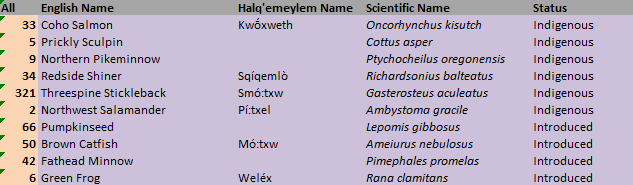
Community Composition Traps (aka Feddes and Gee Traps) will be continued in April and August to collect information about which species are present throughout the Slough. We prioritize monitoring for our native fish species including salmon and trout, but also account for the number of invasive species that cause competition or predation to the salmonids.
This summer we will continue to work towards better water connectivity by hand-digging an area of the slough that has been disconnected by canary grass. This will allow for more fish passage into the upper reaches of the Maria Slough. Furthermore, next winter a project called Z-Slough will happen to increase connectivity from Maria Slough to Lizzie Lake. This project will also include the addition of rearing habitat for salmonids, planting of native plants, and sheltering woody debris for many species added to this restoration site.
What we heard at the Ripple Report: 2025 Status of the Slough
A summary of the most frequent feedback from the 2026 Ripple Report event, plus the recorded presentation, will be added here shortly.
2025 Updates
Fall 2025 Update
Spawner surveys were conducted by our junior biologists throughout the fall and winter season. Our team was also joined by land-based learning from the Seabird Island school. Students participated in surveying, counting all the live spawners they could see in the channel and determining their species. Students also had the opportunity to process carcasses that had washed up on shore, first learning how to identify the species, then measure and sex the carcasses. Finally, students learned how to take scale samples and cut the heads for lab analysis. This will happen again this 2026 spawning year, and we are excited to have the students out with other future field-work opportunities.
Summer 2025 Update
The completion of community trapping, invasive plant management, and our Chaplin Road project occurred during the summer months of 2025. The project included the addition of deeper pools with woody debris for better salmon fry habitat. It also included the removal of canary grass and plant watering to help the success of the native plants throughout the summer months and help the plants grow. In January of 2026 the Chaplin Rd project had more native plant species added to the restoration site to increase future shading of the channel.
$1.8 Million to Ramp Up Salmon Stewardship Efforts | Pacific Salmon Foundation | Bringing Endangered Chinook Back to Maria Slough
You can learn more about our 2025 Chaplin Rd project: Read the Full Article on the PSF Website
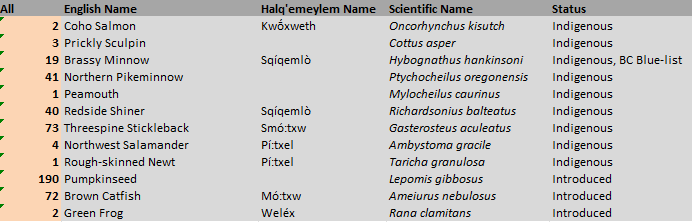
Species present during May 2025 trapping session:

Species present during August 2025 trapping session:
Historical Ripple Reports: Status of the Slough, 2023-2025
2025 Status of the Slough
2024 Status of the Slough
- Attendees were interested in hearing about our monitoring program, including spawner surveys and water quality monitoring. Future monitoring and restoration plans in other areas of Maria Slough were identified as an area of interest.
- Community members support multi-year collection of data and look forward to hearing how dissolved oxygen levels, spawning periods and locations, and water depth compare — and how we’ll use this information to coordinate our efforts. We’ll make more effort to communicate these in our newsletters and website updates.
- A strong emphasis was made on the importance of Salmon and Sturgeon for Seabird Island and on prioritizing the protection and restoration of their habitats. Wildlife species of concern such as bats, bears, amphibians, and other fish were also noted.
- Participants were especially interested in: flood protection plans for opening the north end of Maria Slough to the Fraser River; what a reconnection to the Fraser will look like; long-term monitoring and restoration plans and improving fishing opportunities; how agricultural run-off impacts the health of Maria Slough; how salmon-focused restoration affects other species; and advocating for reduced commercial-recreation fishery impacts on Fraser River Sturgeon.
2023 Status of the Slough
- Attendees were interested in hearing about our monitoring program, including spawner surveys and water quality monitoring. Future monitoring and restoration plans were identified as an area of interest.
- Community members support multi-year collection of data and look forward to hearing how dissolved oxygen levels, spawning periods and locations, and water depth compare.
- A strong emphasis was made on the importance of Salmon and Sturgeon for Seabird Island and on prioritizing the protection and restoration of their habitats.
- Participants were interested in: non-salmonid species at Seabird Island; the impact of invasive species; long-term monitoring and restoration plans and reaching food security; how agricultural run-off impacts the health of Maria Slough; and how salmon-focused restoration affects other species.
Our team works to address questions and feedback from these events. Questions or comments any time: FishandWildlife@seabirdisland.ca. We encourage the community to share observations and photos for future presentations — all photos are credited and used with prior permission.
Bob Chamberlin — First Nation Wild Salmon Alliance
Bob Chamberlin, chairman of the First Nation Wild Salmon Alliance, urges the Government of Canada and the Province of British Columbia to follow through on their commitment to transition away from open-net pen aquaculture off the coast of BC.
Seeking More Information?
For more information on Seabird Island’s fisheries management and environmental stewardship, please contact:
Jillian Stewart-Szpak, RPBio
Natural Resources and Referrals Team Lead
Phone: (604) 796-6885
Email: FishandWildlife@seabirdisland.ca
Seabird Island actively advocates for sustainable fisheries and habitats in our territory. We welcome your questions and input on these important efforts. Reach out to discuss fisheries, restoration projects, volunteering, and more.